
Klibberen
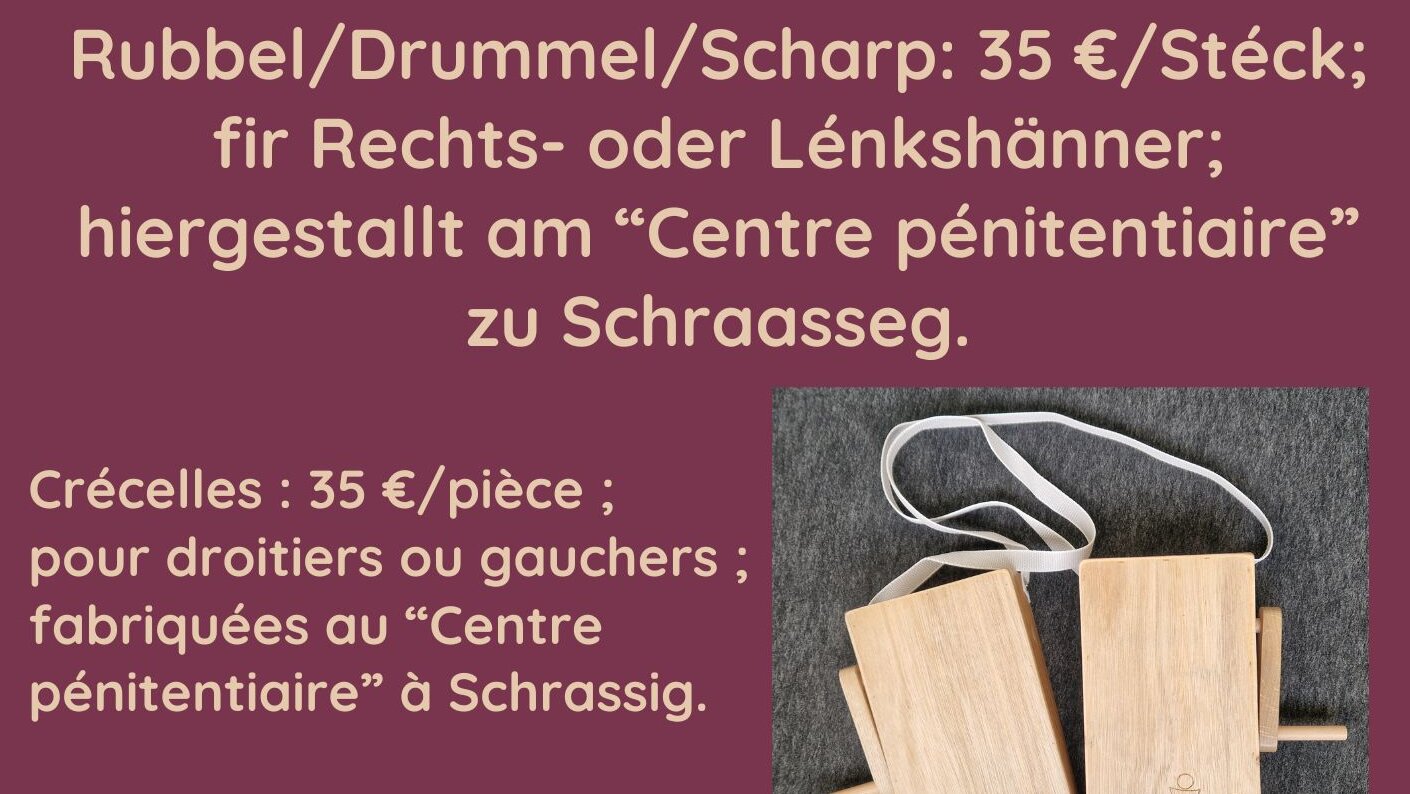
Rubbel/drummel/sharp, for right or left-handed people; manufactured at the "Centre pénitentiaire" in Schrasseg.
During the "Klibberen", the "Klibberkanner" (children with their rattles) travel around their village with their instruments, called "Klibberen" (rattles; there are different models of these wooden instruments), at the end of Holy Week (the week before Easter) and thus replace the bells (for the Angelus and for liturgical celebrations) which do not ring during this period. They shout in a loud voice the sayings appropriate to the time of day.
The tradition of “Klibberen” goes back centuries. During the Second World War, the occupiers banned “Klibberen”. After the Second World War, the tradition of “Klibberen” resumed immediately.
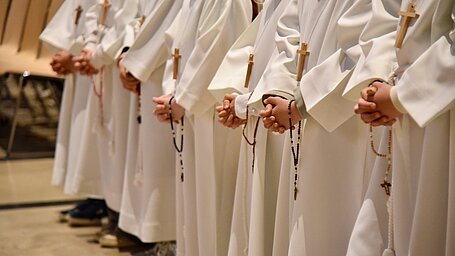
In the past, the "Klibberen" was reserved for altar servers or "Klibberjongen" (boys with their noisemakers), but today there are many girls who participate and therefore the term "Klibberkanner" seems more appropriate. Children and young people of different cultures, ages, religions, etc. come together today to perpetuate this tradition. Even adults, who have often already participated as children, take part: they accompany the young people for safety reasons, show them how to do it and teach them local sayings. Instruments are passed down and reused from generation to generation.
It is only at the end of Holy Week, on Good Friday and Holy Saturday, that the "Klibberkanner" roam the streets of the villages of our country morning, noon and evening with their "Klibberen", to replace the sound of bells, since the liturgy stipulates that bells are not rung from Maundy Thursday evening until the celebration of the Easter Vigil (sunset on Holy Saturday). In some places, children also walk through their village on Maundy Thursday evening, after the bells have been turned off during mass.
On Holy Saturday (or sometimes, in some places, Easter Sunday), children collect their rewards (Easter eggs, sweets, money) by passing through the village in ornately decorated carts and using specific sayings.
As part of sustainable development, the “Klibberen” promotes social cohesion in our country and marks living together over time and space across generations.
The “Klibbere Goen” was included on December 20, 2022 by the ministry of culture in the national inventory of intangible cultural heritage of Luxembourg (www.iki.lu).
On social media: #klibberen #klibberegoen
Lëtzebuerger Massendénger
Centre Convict (Bloc A, 2.Stack)
5 avenue Marie-Thérèse
L-2132 Lëtzebuerg
tel: 44 743 243
Fax: 44 743 248
www.cathol.lu/massendenger
Merci, datt dir dësen Artikel gelies hutt. Falls dir wëllt iwwert d'Aktualitéite vun der Kathoulescher Kierch zu Lëtzebuerg informéiert bleiwen, dann abonnéiert Iech fir d'Cathol-News, den Newsletter, deen all Donneschdeg erauskënnt, andeems dir hei klickt.
Headlines
-
D’Mass vum 11. Oktober gëtt vu Käl iwwerdroen
D'Sonndesmass an de Medien
-
Jahrestag der Erwählung der Trösterin der Betrübten zur Patronin der Stadt Luxemburg
Votum Solemne am 10. Oktober 2026 um 15.00 Uhr in der Kathedrale
-
„Europa, woher kommst du, wohin gehst du?“
Unter diesem Titel stand die 63. internationale Priestertagung der I.P.T. EUROPAX.
-
L'Archidiocèse de Luxembourg publie son rapport d'activités 2025-2026
Une année d'Église en chiffres et en visages : vie pastorale, rencontres internationales, solidarité et transparence financière.